Drywood termite localized remediation provides an engineered perimeter and target barrier when infesting populations of Cryptotermes brevis remain confined to accessible elements of a structure. In older architectural…
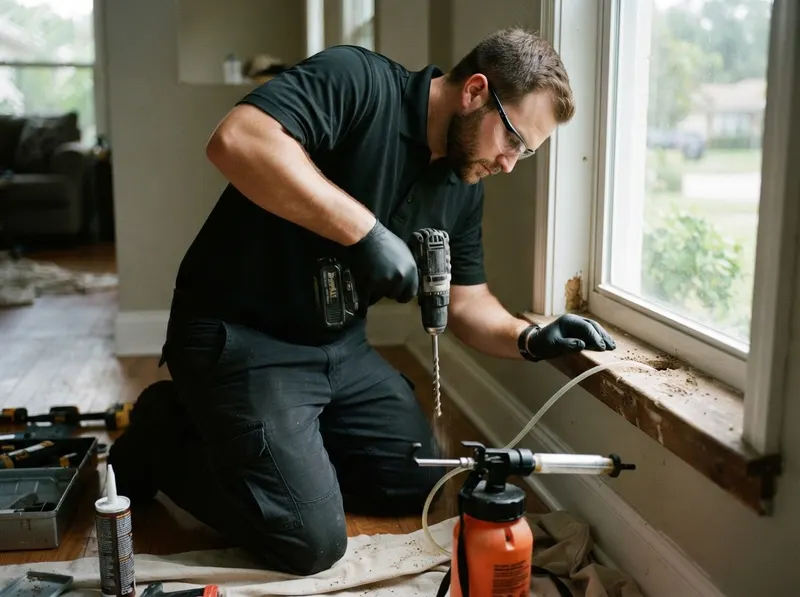
Drywood termite localized remediation provides an engineered perimeter and target barrier when infesting populations of Cryptotermes brevis remain confined to accessible elements of a structure. In older architectural designs found across Hyde Park, Seminole Heights, and the Ybor City Historic District, original heart-pine framing and tongue-and-groove siding frequently develop isolated infestations that do not require full-structure fumigation under tarping. According to biological data from the University of Florida Entomology Department, West Indian drywood termites require no ground contact, extracting their metabolic moisture entirely from wood cellular fibers. Field personnel inject micro-emulsified non-repellent active ingredients directly into structural kick-out galleries identified by hexagonal fecal pellets, allowing distribution throughout the nest without chemical drift into indoor living airspaces. Guidelines maintained by the Florida Department of Agriculture and Consumer Services confirm spot applications serve as an approved standard when infestations are localized to discrete building components.
Selecting localized eradication over whole-building sulfuryl fluoride gas fumigation represents an operational balance between chemical footprint and structural reach. Whole-structure gas reaches concealed wall cavities behind lathe and plaster; spot treatments address confirmed, isolated harborage zones without requiring home evacuation, food bagging, or utility shutoffs. In concrete-block slab construction common across Carrollwood, Westchase, and Ballast Point, drywood colonies routinely localize inside attic rafters, crown molding, or custom kitchen cabinetry near moisture intrusions documented along roof eaves. The U.S. Fish and Wildlife Service and Environmental Protection Agency Safe Pest Control guidelines encourage targeted chemical placements to limit environmental loading across sensitive coastal watersheds like Davis Islands and Palma Ceia. Localized treatments carry specific operational boundaries: if inspection reveals that drywood alate swarming has penetrated multiple concealed exterior wall cavities or inaccessible floor joists, localized remediation ceases to be structurally viable, and complete enclosure methods must be considered.
Field technicians confirm localized colony parameters using visual optical scopes, density impact sounding, and moisture verification mapped to standards outlined by the National Pest Management Association. Remediation proceeds through three verifiable steps: First, technicians drill 1/8-inch access injection ports every 4 to 6 inches along structural grain lines to penetrate the inner gallery walls. Second, specialized foam carrying termiticidal formulations approved under the National Institute of Standards and Technology materials testing criteria is pressurized to expand into every branch of the internal chamber. Third, injection voids are sealed with structural wood dowels to prevent re-entry. In neighborhoods bordering the Tampa Riverwalk, Tampa Heights, and Al Lopez Park, localized remediation functions alongside architectural preservation protocols overseen by the Secretary of the Interior Standards for Rehabilitation, ensuring the preservation of historic millwork. Property owners needing remediation can contact BugLine Protection Co. by dialing (656) 250-2992 to arrange an on-site inspection across Hillsborough County, or reach out to the UF/IFAS Hillsborough County Extension to review regional pest management resources.
Every job gets a firm, written price after a free on-site visit.
For standards, safe disposal, and service guidance on PEST CONTROL SEVICE in Tampa, FL, useful references include U.S. EPA, ENERGY STAR, U.S. Dept. of Energy, Consumer.gov, U.S. Census Bureau, and Google Maps. General consumer and small-business resources are available from USA.gov, Better Business Bureau, FTC Consumer Advice, U.S. Small Business Administration, and Ready.gov.
Tell us about your drywood termite localized remediation job in Tampa and we'll send a clear, written quote, usually the same day.
 BugLine Protection Co.